
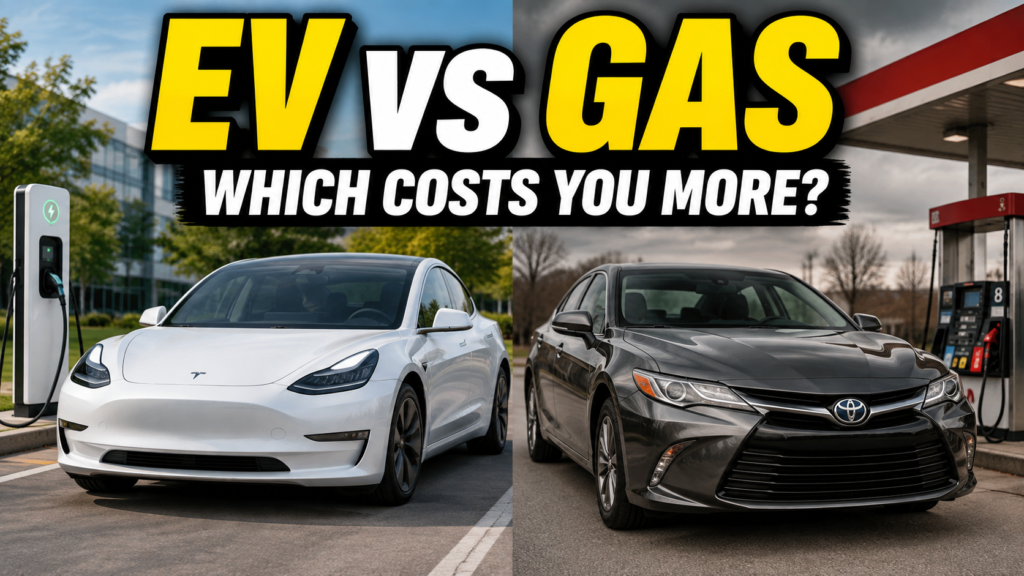
EV vs. Gas: Which Cars Steal Your Savings?
You just paid $50,000 for an electric car. In 5 years it’ll be worth $20,600. You lost $29,400. Meanwhile, your neighbor bought a hybrid for $35,000. In 5 years it’s worth $20,800. They lost $14,200. Same time period, but you just hemorrhaged an extra $15,200 because you went full electric instead of hybrid.
This is the lie nobody’s telling you about EVs. They’re supposed to save you money, but they’re destroying your wealth faster than almost any other car you can buy. And gas cars? Some of them are just as bad. I’m going to show you exactly which cars are financial black holes and which ones will actually protect your money.
The 2026 Depreciation Crisis
Here’s what’s happening right now in the car market. EVs are losing 58.8% of their value over 5 years. That’s worse than the industry average of 45.6% for all vehicles. Gas cars are sitting right at that 45.6% average. But hybrids? They’re only losing 40.7% over 5 years. Hybrids are beating both EVs and gas cars when it comes to holding value.
Let me put that in real dollars. If you buy a $45,000 EV today, in 5 years it’ll be worth $18,540. You lost $26,460. If you buy a $45,000 gas car, in 5 years it’s worth $24,480. You lost $20,520. If you buy a $45,000 hybrid, in 5 years it’s worth $26,685. You lost $18,315. The hybrid saved you $8,145 compared to the EV and $2,205 compared to the gas car.
And this gap is getting worse for EVs, not better. Back in November 2022, hybrids less than 2 years old were holding 90% of their original value and EVs were at 88%. Pretty close. Fast forward to July 2025 and hybrids less than 2 years old are still maintaining 68% of their value. EVs, on the other hand, dropped to 49%. That’s a 19 percentage point gap opening up in less than 3 years.
Here’s what this means for you. If you bought an EV thinking you’d save money, you’re not. You’re burning cash on depreciation faster than you’re saving it on gas. And if you’re about to buy an EV in 2026, you need to understand you’re walking into the worst depreciation market for electric vehicles we’ve ever seen.
Why Hybrids Are Crushing Both EVs and Gas Cars
Hybrids are in massive demand right now because they solve the problems that both EVs and gas cars create. You get the fuel savings of an electric motor without the range anxiety or charging infrastructure headaches. You get the reliability of a gas engine without burning through fuel costs. It’s the best of both worlds, and the market knows it.
The Toyota RAV4 Hybrid is the king of value retention. It only loses 31.2% of its original price over 5 years. That’s an average loss of $10,062 on a car that starts around $32,250. Compare that to a Tesla Model S losing 61.53% over 5 years, or $74,132 in actual dollars, and you start to see why hybrids are the smart play.
The Toyota Prius loses 34.9% over 5 years, just $9,908 in depreciation. The Honda Civic Hybrid retains 66.6% of its value after 5 years. The Toyota Corolla Hybrid retains 65.9%. These are numbers that gas cars and EVs can’t touch.
Why are hybrids holding value so well? Three reasons. One, fuel efficiency without the battery replacement risk. Hybrid batteries are smaller, cheaper to replace, and have proven themselves over 20-plus years of real-world use.
Two, they’re not dependent on charging infrastructure. You fill them up with gas like any other car, so buyers aren’t worried about range or finding chargers.“Three, demand is exploding. In multiple major markets and in the U.S., hybrids are one of the few segments still selling at or above MSRP, which keeps resale values high.”
Here’s the insider truth. When gas prices spike, hybrid values go up because everyone wants fuel efficiency. When gas prices drop, hybrid values stay stable because buyers still want reliability and lower emissions. Gas cars lose value when fuel is expensive because nobody wants a gas guzzler. EVs lose value constantly because technology is changing so fast that a 3-year-old EV feels outdated compared to new models with better range, faster charging, and updated software.
Gas Cars: The Middle Ground That’s Losing Ground
Gas cars are depreciating at the industry average of 45.6% over 5 years, but some models are doing way worse. The Chevrolet Trailblazer is the only mainstream gas-powered vehicle on the worst depreciation lists, and it’s getting hammered for reasons nobody fully understands. It’s a decent car with no major issues, but it’s losing value faster than its competitors.
Luxury gas cars are also getting destroyed. The Audi A6 loses over 60% of its value in 5 years. The BMW 5 Series and 7 Series are on the fastest depreciation lists. The Maserati Ghibli and Levante are losing massive amounts. These are $60,000 to $100,000 cars that become $30,000 to $40,000 cars in 5 years.
Why? Luxury buyers want the latest tech and features. A 5-year-old luxury car with outdated infotainment and missing the newest driver-assist features doesn’t command premium prices. Plus, luxury car maintenance is expensive, and buyers know it. A used BMW with potential $3,000 repair bills scares people away, which lowers prices.
But here’s the thing. The right gas cars still hold value decently. Toyota and Honda gas models depreciate slower than the average. The Honda Civic, Toyota Camry, and Toyota Tacoma all hold value well because they’re reliable, cheap to maintain, and there’s always demand for them. If you’re buying a gas car and want to protect your investment, stick with proven reliable brands.
The problem is that gas cars are stuck in the middle. They don’t have the fuel efficiency of hybrids, so they’re less appealing when gas prices spike. They don’t have the wow factor of EVs, so they’re less appealing to tech-forward buyers. They’re just cars, and in a market where hybrids offer better efficiency and EVs offer cutting-edge tech, plain gas cars are losing their appeal.
Here’s what you need to understand. If gas prices stay high or go higher, gas car values will drop because nobody wants to pay $80 to fill up a tank every week. If emissions regulations get stricter, gas cars will lose value because buyers will worry about future resale when ICE bans start rolling out in certain states. And if hybrids keep getting cheaper and more available, gas cars lose their price advantage.
The Used Car Sweet Spot
Here’s where this gets interesting for buyers. If you’re shopping used, EVs and luxury gas cars are your opportunity. Someone else already ate the depreciation, so you can buy a 3-year-old Tesla Model 3 for 53% less than it cost new. That’s a $29,315 discount. Or you can buy a 3-year-old Audi A6 for way less than new and enjoy a luxury car without the new-car price.
But you have to be smart about it. For EVs, check the battery warranty remaining. If there’s less than 3 years or 50,000 miles left on the warranty, negotiate hard because the next owner might be staring at a $15,000 replacement bill. Get a pre-purchase inspection from a shop that specializes in EVs. Check the charging history if possible. Fast charging degrades batteries faster than slow charging, so a car that was fast-charged constantly is worth less than one that was slow-charged at home.
For luxury gas cars, budget for maintenance. A used BMW or Mercedes will nickel and dime you with repairs. Set aside $2,000 to $3,000 per year for unexpected costs. Get a pre-purchase inspection from a mechanic who knows European cars. Check for service records. A well-maintained luxury car can be reliable. A neglected one will bankrupt you.
And here’s the move most people miss. Buy a 2 to 3-year-old hybrid. You avoid the worst depreciation hit from years 1 and 2, but the car is still under warranty and has most of its life ahead of it. A 3-year-old RAV4 Hybrid costs $7,260 less than new on average, but it’s still retaining 75% of its value. You get the discount without the risk.
Which Cars to Buy In 2026
If you’re buying new, here’s your playbook. Buy a hybrid from Toyota or Honda. The RAV4 Hybrid, Prius, Camry Hybrid, Corolla Hybrid, Honda Civic Hybrid, and Honda CR-V Hybrid are all safe bets. You’ll lose less money on depreciation, fuel costs will be low, and resale value will stay strong.
Avoid new EVs unless you’re planning to keep the car for 10-plus years. If you can absorb the depreciation hit and you don’t care about resale value, fine. But if you’re planning to trade in after 3 to 5 years, you’re going to take a massive loss. The only exception is if you’re getting a heavily discounted EV deal where the price is already so low that further depreciation doesn’t matter.
For gas cars, stick with Toyota, Honda, and Subaru if you want value retention. Avoid luxury brands unless you’re leasing. And stay away from full-size trucks and SUVs unless you actually need the capability, because fuel costs and depreciation will eat you alive.
If you’re buying used, target 2 to 3-year-old hybrids for the best value. If you want to gamble on an EV, buy one that’s 3 to 4 years old where someone else ate the depreciation, but make sure the battery warranty has at least 3 years remaining. And if you want a luxury car, buy used and budget for repairs.
Here’s the bottom line. In 2026, hybrids are the financial winner. They depreciate slower, fuel costs are low, maintenance is reasonable, and demand is high. EVs are financial losers unless you’re keeping them forever. Gas cars are stuck in the middle, losing value faster than hybrids but slower than EVs.
The Bottom Line
You’re not just buying a car. You’re making a $20,000 to $30,000 depreciation bet. If you pick wrong, you lose. If you pick right, you save.
Hybrids are winning because they solve real problems. You get fuel efficiency without range anxiety. You get reliability without massive battery replacement risk. And you get strong resale value because demand is exploding.
EVs are losing because technology is changing too fast, prices are dropping, and battery replacement fears scare buyers. A 5-year-old EV with outdated range and charging speeds is worth half what you paid.
Gas cars are stuck in the middle. Some hold value decently, but most are losing ground to hybrids.
If you bought an EV 3 years ago, you’re underwater. If you’re about to buy one in 2026, understand you’re walking into a depreciation trap. And if you’re smart, you’ll buy a hybrid, drive it for 10 years, and watch everyone else lose money while you keep yours.
Don’t fall for the hype. Do the math. Know what you’re losing. And if the numbers don’t work, walk away.
