
My verdict
I never judge a vehicle deal from the monthly payment or the advertised price alone. I want the complete out-the-door total, with the documentation fee, taxes, title, registration, dealer products, and every other charge shown on separate lines. A documentation fee may be legitimate, but I want the dealer to explain it clearly and show me how it changes the final price before I decide whether the car is worth buying.
A dealer documentation fee is a charge a dealership says covers paperwork, processing, electronic filing, contract preparation, or administrative work. The label can vary, and the rules can vary depending on where the vehicle is sold and registered. That is why I do not assume a fee is automatically illegal, automatically negotiable, or automatically fair.
My first request is simple: send me a written, itemized out-the-door quote for the exact vehicle. The FTC guidance on getting an out-the-door price in writing recommends asking for the total price, including charges and fees, before visiting the lot. I want to see the selling price, documentation fee, government charges, taxes, registration, optional products, financing conditions, and final total. I also want to know whether any advertised price depends on a trade-in, a finance approval, a rebate, or a product I did not ask for.
This guide does not state a universal documentation-fee cap. Fee rules are location-specific. Before challenging a fee, check the official state DMV, attorney general, or motor-vehicle regulator page for the state where the transaction is completed, then compare that information with the dealer’s written quote.
Before you negotiate the fee, check whether the asking price is already above the market.
What a documentation fee may cover
Dealers commonly describe a documentation fee as payment for preparing contracts, processing a purchase, completing electronic paperwork, handling registration documents, or maintaining administrative systems. Some dealers use a different name for a similar charge, such as a processing fee, paperwork fee, filing fee, administrative fee, or dealer service fee.
The name is less important than the disclosure. I want the dealer to state what the fee covers, whether the fee is charged to every buyer, whether it is already included in the advertised price, and whether any separate fee duplicates the same work. If I see both a documentation fee and a separate paperwork or electronic filing fee, I ask why both are necessary.
I also ask whether the fee applies to cash buyers and financed buyers. A different total for financing may reflect lender-related products or conditions rather than the documentation fee itself. I want those items separated so I can compare dealers fairly.
Questions I would ask the dealer
- What specific work does this documentation fee cover?
- Is it charged to every buyer or only to financed purchases?
- Is the fee already included in the advertised price?
- Are there any separate processing, electronic filing, preparation, or administrative charges?
- Which lines are government charges and which are dealer charges?
- Which products are optional and can be removed?
- Does the advertised price require financing, a trade-in, a rebate, or a membership?
- Can you send the complete out-the-door quote in writing before I visit?
Hypothetical itemized quote
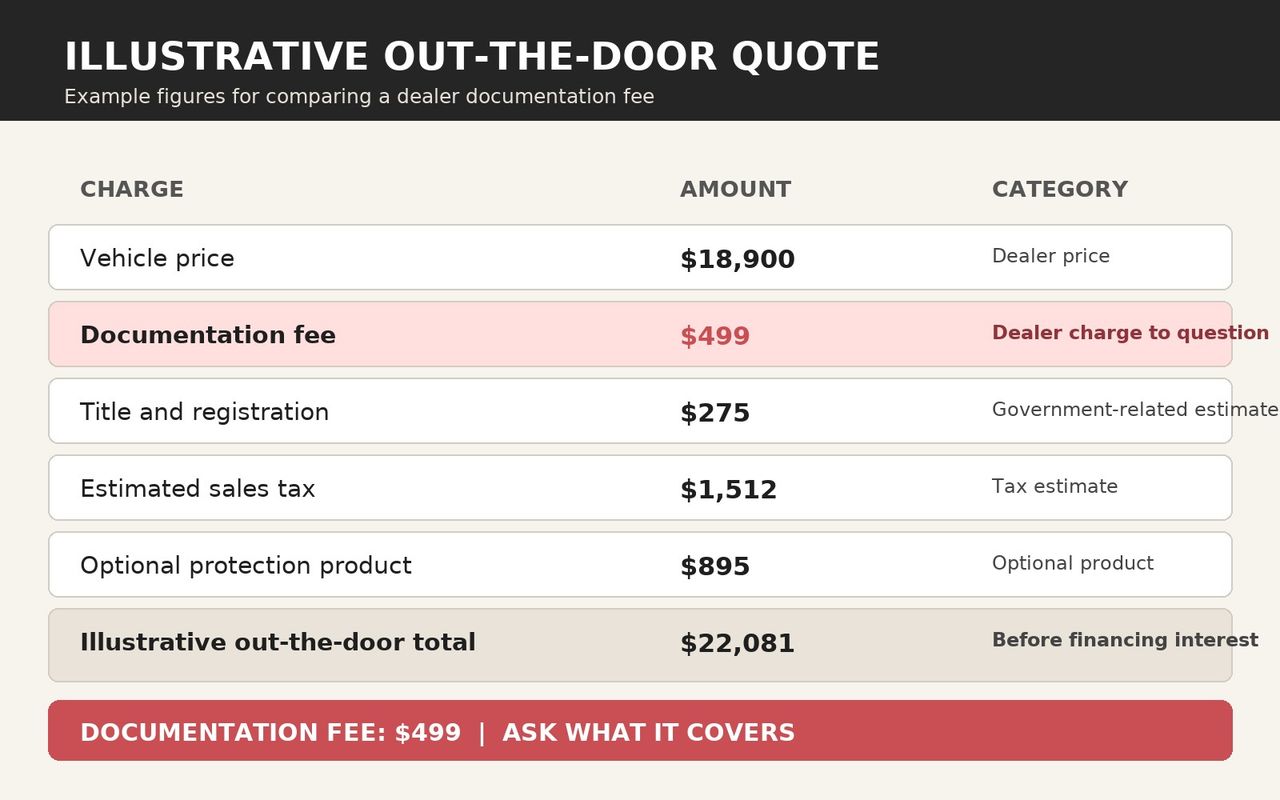
The following quote is hypothetical and illustrative only. It is not a statement of any state’s permitted fee, tax rate, or required charge.
| Charge | Illustrative amount | How I would classify it |
|---|---|---|
| Vehicle price | $18,900 | Dealer price |
| Documentation fee | $499 | Dealer charge to question |
| Title and registration | $275 | Government-related estimate to verify |
| Estimated sales tax | $1,512 | Tax estimate to verify |
| Optional protection product | $895 | Optional product to decline or compare |
| Illustrative out-the-door total | $22,081 | Before financing interest |
In this example, I would not treat the $22,081 total as fixed or legally accurate for a particular buyer. I would ask the dealer to identify the source of every line, confirm the actual tax and registration figures, and remove the optional protection product unless I had chosen it after comparing its value and price.
The documentation fee is only one part of the difference between the vehicle price and the final total. A dealer with a lower documentation fee can still produce the more expensive deal if it adds a larger protection package, markup, warranty, reconditioning charge, or other product.
How I compare two dealers
I compare dealers using the same vehicle-price basis and the same requested options. I do not compare Dealer A’s monthly payment with Dealer B’s cash price. I ask both dealers for an out-the-door quote before financing interest and before allowing a trade-in to obscure the numbers.
| Line item | Dealer A | Dealer B |
|---|---|---|
| Vehicle price | $18,900 | $18,450 |
| Documentation fee | $499 | $899 |
| Government charges and tax estimate | $1,787 | $1,750 |
| Optional products | $0 | $895 |
| Illustrative out-the-door total | $21,186 | $21,994 |
Dealer B has the lower vehicle price, but the higher documentation fee and optional product make the complete total higher in this illustration. That is why I compare the final written number instead of declaring a winner from one line item.
I also check whether both dealers are quoting the same vehicle. The trim, mileage, accident history, equipment, warranty, tyres, service history, and included accessories can change the value. A lower out-the-door price is not automatically better if the vehicle is materially different or needs immediate work.
How I would question a documentation fee
I would stay direct and calm. I would not accuse the salesperson of breaking a rule unless I had checked the applicable official state source and understood the transaction. My goal is to get a complete quote and decide whether the total works for me.
I might say: “Please show me exactly what the documentation fee covers and identify every other dealer charge. I am comparing complete out-the-door totals, not monthly payments. If the fee is fixed, please leave it on the quote and show me whether the vehicle price can be adjusted so I can compare the total fairly.”
That approach keeps the conversation focused on the total. A dealer may not remove the fee, but the dealer may adjust another part of the deal. The number I care about is the final price for the exact vehicle under the exact purchase conditions.
Message buyers can copy and send
Hi, I’m interested in the vehicle, but I compare complete out-the-door prices rather than monthly payments. Please send me an itemized quote for this specific vehicle showing the selling price, documentation fee, taxes, title, registration, every dealer charge, and each optional product on a separate line. Please mark each amount as required or optional and show the complete total before financing interest. If the advertised price depends on financing, a trade-in, a rebate, or a product, please show that condition clearly. I will review the written total before arranging a visit or placing a deposit.
What official information I would check
Fee rules depend on the location of the sale and registration. I would check the official state DMV, attorney general, or motor-vehicle regulator page for the relevant state. I would look for current information about dealer disclosures, advertised prices, documentation or processing fees, required itemization, and any applicable limits or conditions.
I would save a copy of the official page and the dealer’s quote. I would also confirm that the source applies to the transaction I am considering. A rule for a new-car franchise, a used-car dealer, a private sale, or a different registration location may not apply in the same way.
I would not rely on a forum comment or a salesperson’s statement as the only authority. If the state source is unclear, I would ask the dealer to identify the rule or disclosure basis for the charge and then verify it independently.
Red flags in a quote
- The vehicle price changes when I ask for a cash price.
- The advertised price requires financing or a trade-in that was not obvious.
- The documentation fee appears more than once under different names.
- An optional product is included without a clear yes-or-no choice.
- The seller refuses to provide an itemized quote before a deposit.
- The total is shown only as a monthly payment.
- Taxes and registration are presented as dealer profit.
- The vehicle in the quote does not match the VIN, trim, mileage, or advertised equipment.
What I would do with optional products
I would ask for the quote with every optional product removed first. Then I would request a separate price for any product I might genuinely want. That makes it easier to compare the core vehicle deal with the cost of warranties, protection packages, nitrogen, etching, service plans, or other add-ons.
I would not allow an optional product to be described as mandatory without asking for the reason in writing. If the dealer says the product is required by a lender, I would ask for the lender’s written condition and compare the financing terms without assuming the dealer’s product is the only option.
How the fee affects negotiation
A documentation fee can be a negotiation issue, but it is not always the only or best place to negotiate. If the fee is fixed for every buyer, I would ask whether the vehicle price can be adjusted instead. If the fee is discretionary, I would ask whether it can be removed. If neither is possible, I would compare the complete total with another dealer.
I would also consider the vehicle’s market position. A dealer may defend a higher fee because the car is priced aggressively, while another dealer may advertise a lower fee but price the car higher. Deal Check can help me test the vehicle’s asking price before I decide how much negotiation room exists.
When I would proceed
I would proceed when I have the VIN, a complete written quote, a clear explanation of the documentation fee, a realistic tax and registration estimate, no unexplained duplicate charges, and a price that compares well with similar vehicles. I would also want an independent inspection unless the vehicle is new enough and covered by a warranty that genuinely addresses the risks I care about.
I would make sure the final contract matches the quote. A verbal promise is not enough if the number changes in the finance office.
When I would pause or walk away
I would pause if the dealer will not provide the quote in writing, will not identify optional products, or keeps redirecting the conversation to monthly payment. I would also pause if the documentation fee is unclear under the applicable state guidance or if the final number changes without explanation.
I would walk away if the seller refuses to disclose the complete total, adds products after I declined them, changes the vehicle price because I asked to pay cash, refuses an independent inspection, or pressures me to place a deposit before I can verify the quote and vehicle.
There is no prize for winning an argument over one fee and buying an overpriced car. I want a transparent total for a vehicle that makes sense.
Related buyer guides
Read the dealer add-ons and hidden-fees guide, learn how to choose an opening offer, and compare used-car asking prices.
Bottom line
A documentation fee is one line in the deal, not the whole deal. I would ask what it covers, verify any applicable state guidance, separate dealer charges from government charges, remove optional products for the first comparison, and compare the complete written out-the-door total between dealers.
Before you make an offer, compare the full price instead of the monthly payment.