
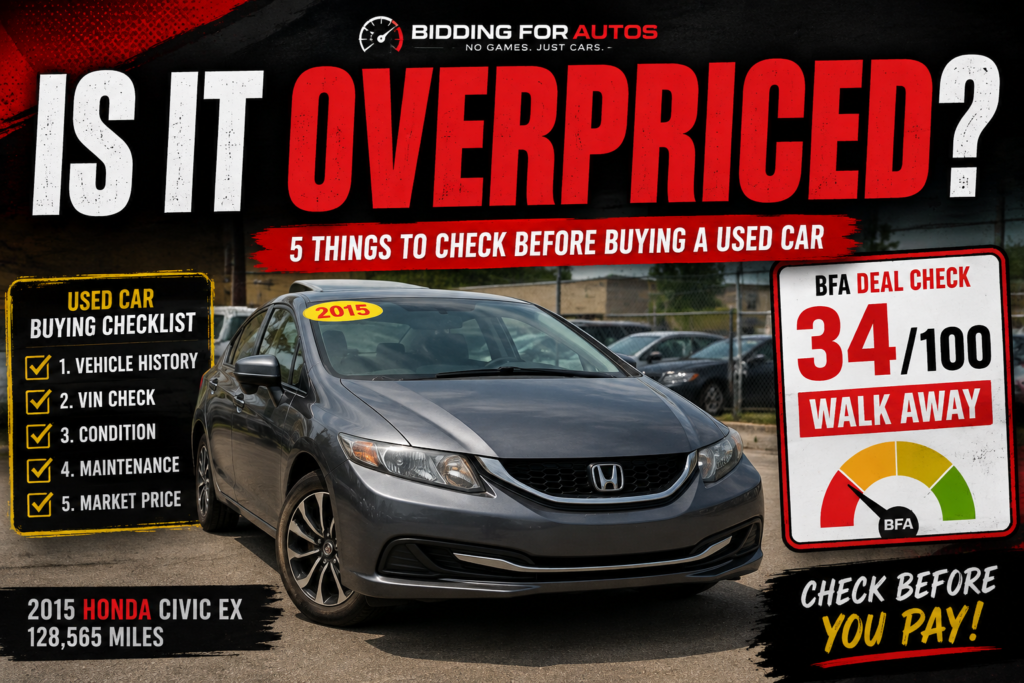
A strong Deal Check score is a great start — but it shouldn’t be the end of your research. Before you hand over any money, run through this checklist.
A used car can look perfect in photos, drive well for ten minutes, and still hide thousands of dollars in problems.
Before you hand over any money, you need to look beyond the paint, mileage, and monthly payment. A strong Deal Check score is a great start, but price is only one part of a smart used-car purchase.
Here are five things you should check before buying any used car.
1. Vehicle History
Pull a vehicle history report and look for previous accidents, salvage or rebuilt titles, flood damage, reported odometer problems, and inconsistencies in the ownership history.
Pay particular attention to where the vehicle has lived. A car that spent years in an area affected by major flooding deserves additional inspection, even if the interior looks spotless today.
Accident history doesn’t automatically make a used car a bad purchase. A properly repaired minor accident can be acceptable at the right price. Structural damage, repeated accidents, airbag deployment, or questionable repairs deserve much more caution.
Also compare the history report with what the seller tells you. If the seller says the car has never been damaged but the report shows an accident, ask questions before going any further.
Red flags: salvage or rebuilt title, flood history, unexplained mileage changes, repeated accidents, or large gaps in the vehicle’s history.
2. VIN Verification
Check the Vehicle Identification Number before you buy.
Make sure the VIN displayed on the dashboard matches the VIN on the driver’s-door label, vehicle listing, title, registration, and purchase paperwork.
A simple typo can happen, but unexplained VIN differences are a serious warning sign.
The VIN can also help you verify the vehicle’s exact year, make, model and configuration. That’s important because two vehicles that look almost identical can have very different market values depending on their trim and equipment.
Use the VIN to check for open safety recalls as well. Recall repairs are generally performed by the manufacturer through its authorized dealers at no charge to the owner.
Don’t rely solely on what appears in an online advertisement. Verify the actual vehicle before signing anything.
3. Mechanical Condition
This is where an inexpensive used car can quickly become expensive.
Whenever possible, arrange an independent pre-purchase inspection before buying. Ideally, use a mechanic who doesn’t work for the seller.
Have the mechanic inspect the engine, transmission, brakes, suspension, tires, cooling system, fluid condition, leaks, warning lights and evidence of previous repairs.
Then take the car on a proper test drive.
Don’t just drive around the dealership parking lot. Accelerate normally, brake firmly, drive at highway speed if possible, make several turns and listen carefully.
Watch for transmission hesitation, vibrations, pulling under braking, unusual engine noises, warning lights or smoke.
One inspection might cost you a little money today. Discovering a failing transmission after you’ve bought the car can cost thousands.
4. Maintenance Records
Mileage tells you how far a car has traveled. Maintenance records can tell you how it got there.
A well-maintained vehicle with 120,000 miles can sometimes be a much better purchase than a neglected vehicle with 70,000 miles.
Ask for oil-change records, major service receipts and documentation for repairs. Check whether important maintenance recommended by the manufacturer has been completed.
The exact maintenance requirements vary by vehicle. Depending on the model, expensive scheduled work could include transmission service, spark plugs, cooling-system maintenance or timing-belt replacement.
If a major service should already have been completed but the seller can’t prove it, assume you may have to pay for it yourself and factor that into your offer.
A seller with a folder full of maintenance receipts is giving you something valuable: evidence.
5. Market Price
Finally, determine whether the asking price makes sense.
Don’t assume a vehicle is fairly priced because the dealer reduced it by $2,000 or advertises it as a “great deal.” The important number isn’t the discount from the dealer’s original price. It’s what comparable vehicles are actually worth.
Compare vehicles with the same year, model, mileage and, where possible, trim.
Mileage matters. Trim matters. Location can matter. Condition matters.
A $20,000 asking price might be excellent if comparable vehicles are selling around $23,000. The same $20,000 could be overpriced if comparable vehicles are closer to $17,500.
This is exactly why we built BiddingForAutos Deal Check.
Enter the used car and its asking price, and Deal Check compares the vehicle against market data to help you understand whether you’re looking at a good deal, a fair deal, or an overpriced car.
Before You Buy
Never judge a used car on one number.
A low price doesn’t erase a bad history. Low mileage doesn’t guarantee good maintenance. A clean-looking car doesn’t guarantee good mechanical condition.
Check the history, VIN, mechanical condition, maintenance records and market value before you commit.
And before negotiating, run the vehicle through Deal Check so you know where the asking price stands before you make an offer.
Your Biggest Advantage Is Knowing the Number Before You Negotiate
Picture walking into a dealership to look at a $17,000 Civic — with no research done.
The salesperson tells you, “We price our vehicles according to the market.” Sounds reasonable enough. Maybe they knock $500 off, and you walk out feeling like you got a deal.
But if comparable vehicles are averaging $14,290, you might still be paying thousands more than you needed to.
Now picture walking in already knowing the numbers.
That’s a completely different conversation.
You don’t have to argue. You don’t have to guess. You simply know where the vehicle sits relative to the market — and you negotiate from there.
Deal Check Is Free to Try
- Opening offer
- Target purchase price
- Maximum price to pay
- Negotiation guidance specific to the vehicle
- Comparable listings behind the valuation
- A final buy, negotiate, or walk-away recommendation
Every paid report is reviewed before release and delivered within 24 hours.
The initial BiddingForAutos Deal Check is free. Enter the vehicle you’re considering, including its mileage and asking price, and Deal Check compares it against current market data to give you a Deal Score.
What We Think
Used-car shopping shouldn’t require guessing whether a dealer’s price is fair.
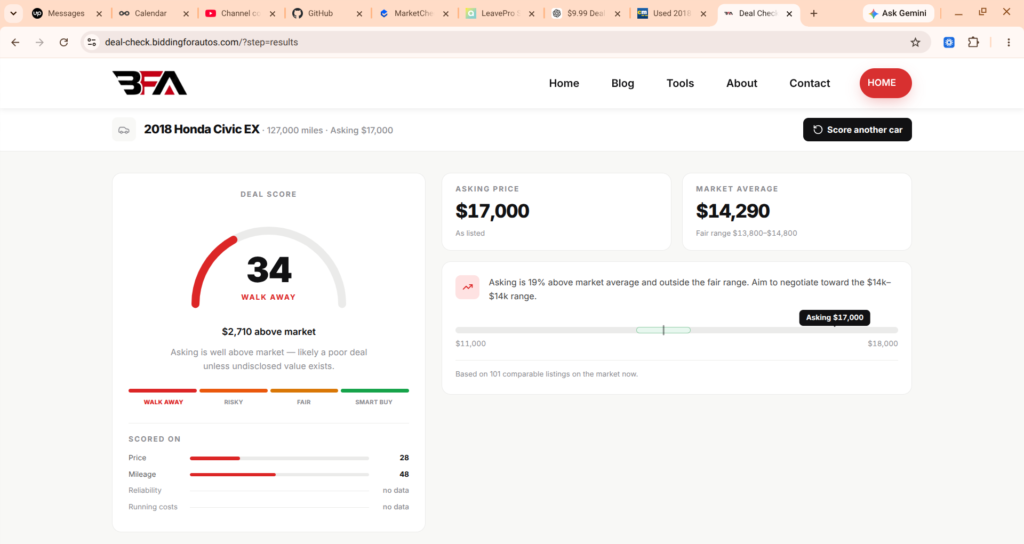
Take the 2018 Honda Civic we tested. At first glance, it’s just another used Civic listed at $17,000.
Then you look at the market:
- 101 comparable listings
- $14,290 market average
- $2,710 above market
- Deal Score: 34/100 — Walk Away
Suddenly the decision looks a lot different.
That’s the point of BiddingForAutos Deal Check — giving you useful information before you make an expensive decision.