
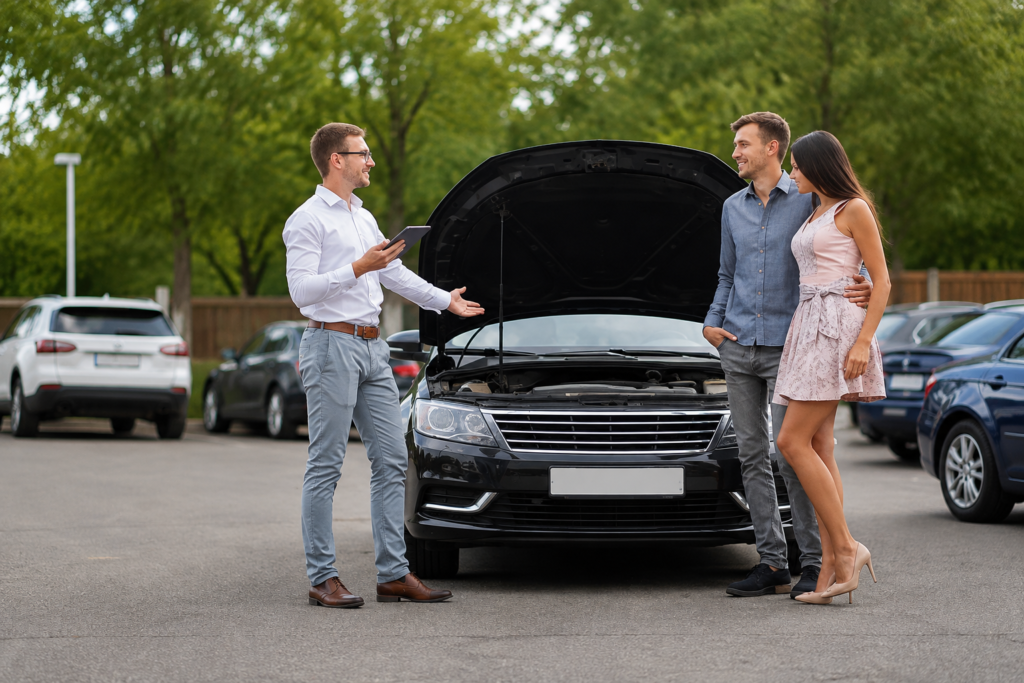
You found the car.
The mileage looks reasonable. The photos are clean. The price doesn’t seem outrageous. The dealer says they’ve already had several people asking about it, and suddenly you feel like you need to make a decision before somebody else buys it.
That’s exactly when buyers make expensive mistakes.
A used car can look like a great deal and still be overpriced by thousands of dollars. A low asking price can hide accident history, neglected maintenance, expensive upcoming repairs, or dealer fees that don’t appear until you’re sitting in the finance office.
So how do you know whether a used car is actually a good deal?
Don’t judge it by the monthly payment or the discount advertised on the windshield. Use these seven checks before you buy.
Not sure whether the asking price is too high? See our guide on how to know if a used car is overpriced.
1. Compare the Price With Similar Cars
The asking price means almost nothing by itself.
A dealer can list a car for $22,000 and advertise a “$3,000 discount,” but that doesn’t make it a bargain if comparable cars are selling for $20,000.
Start by finding at least five similar vehicles.
Try to match the:
- Year
- Make and model
- Trim
- Mileage
- Engine
- Drivetrain
- Condition
- Accident and title history
The closer the comparison, the better.
Don’t compare a base model with a fully loaded version or a 40,000-mile car with one that has 110,000 miles and assume the price difference tells you anything useful.
You’re trying to establish a realistic market range.
If most comparable vehicles are advertised between $19,500 and $21,000 and the car you’re considering is $23,500, the seller needs a good reason for that premium.
If it’s $18,500, don’t automatically celebrate either.
Now you need to figure out why it’s cheaper.
2. Find Out Why the Price Is Low
One of the most dangerous phrases in used-car shopping is:
“It’s too good to pass up.”
Sometimes an unusually cheap car really is a great deal.
Sometimes the price is the warning.
A vehicle priced thousands below comparable cars could have:
- Accident history
- A rebuilt or salvage title
- Mechanical problems
- Poor maintenance history
- Excessive cosmetic damage
- Missing equipment
- Previous rental or commercial use
- A seller who needs it gone quickly
You should also check the VIN for open safety recalls using NHTSA’s recall lookup.https://www.nhtsa.gov/recalls
That doesn’t mean every cheap vehicle is bad.
It means the bigger the discount, the more carefully you should investigate it.
If a car should reasonably be worth $20,000 and somebody is selling it for $15,000, don’t start by asking how quickly you can buy it.
Start by asking why.
A genuine bargain should survive inspection.
3. Look Beyond the Mileage
Used-car buyers often treat mileage like a scoreboard.
60,000 miles? Good.
120,000 miles? Bad.
Real life isn’t that simple.
I’d rather consider a 100,000-mile vehicle with excellent maintenance records than a 60,000-mile example that’s been neglected.
Service history tells you how the previous owner treated the car.
Look for evidence of regular:
- Oil changes
- Transmission servicing when required
- Brake maintenance
- Coolant changes
- Tire replacement and rotation
- Scheduled manufacturer maintenance
- Repairs performed when problems appeared
Also research the specific engine and transmission.
Some vehicles can comfortably handle high mileage when maintained properly. Others can develop expensive problems at mileage levels that don’t look particularly high.
The odometer tells you how far the car has traveled.
The service history helps tell you how it traveled those miles.
4. Calculate the Real Out-the-Door Price
This is where an advertised bargain can disappear.
Imagine you find a car advertised for $19,995.
You negotiate it down to $19,300 and feel pretty good about yourself.
Then the paperwork arrives.
Documentation fee.
Dealer preparation fee.
Paint protection.
VIN etching.
Nitrogen tires.
Warranty package.
Other dealer-installed products you never asked for.
Suddenly your “$19,300 car” costs thousands more.
Before agreeing to anything, ask the seller for an itemized out-the-door price in writing.
You want to see:
Vehicle price + taxes + registration + legitimate fees + optional products = actual amount you will pay.
Pay particular attention to optional dealer products.
You don’t have to buy something simply because it has already been installed on the vehicle or printed on a worksheet.
And don’t let the conversation switch to monthly payments.
A dealer can make an expensive vehicle look affordable by stretching the loan over 72 or 84 months.
Negotiate the price of the car first.
The FTC also provides guidance on what to watch for when buying a used car from a dealer.https://consumer.ftc.gov/articles/buying-used-car-dealer
There are several other expensive mistakes buyers make at the dealership. See our guide to the 8 car buying mistakes that can cost you thousands.
5. Check How Long the Car Has Been for Sale
Time can give you negotiating leverage.
A car that arrived at a dealership three days ago may attract several interested buyers.
A car that’s been sitting there for 70 days is a different story.
Dealers have money tied up in inventory, and vehicles that sit aren’t helping them.
That doesn’t guarantee they’ll accept a huge discount, but an older listing can give you more room to negotiate.
It can also tell you something else.
Ask yourself:
Why hasn’t anybody bought it?
Maybe it’s overpriced.
Maybe the color or configuration isn’t popular.
Maybe buyers inspected it and walked away.
Or maybe it simply hasn’t found the right buyer.
Don’t assume long inventory age means there’s something wrong with the vehicle, but use it as another piece of evidence.
If the car has been sitting for weeks and comparable vehicles are cheaper, you now have a much stronger argument for a lower offer.
6. Get an Independent Inspection
This is one of the best pieces of money you can spend when buying a used car.
A vehicle can look fantastic during a 15-minute test drive while hiding thousands of dollars in upcoming repairs.
Have an independent mechanic perform a pre-purchase inspection whenever practical.
You want someone who isn’t financially involved in selling you the vehicle.
They should check areas such as:
- Engine leaks
- Transmission operation
- Suspension components
- Brakes
- Tires
- Cooling system
- Warning codes
- Undercarriage condition
- Evidence of previous accident repairs
- Fluid condition
- Potential maintenance due soon
Suppose the mechanic finds that the car needs tires, brakes and suspension work.
The seller may still be asking a fair market price for the model—but that particular car isn’t worth the same amount as one that needs nothing.
Now you have useful information.
You can renegotiate, budget for the repairs, or walk away.
All three options are better than discovering the problems after you’ve bought it.
7. Run the Price Through BFA Deal Check
You’ve compared similar cars.
You’ve checked the history and maintenance.
You’ve calculated the out-the-door price.
You’ve inspected the vehicle.
There’s still one question:
Is the asking price actually a good deal?
That’s where BiddingForAutos Deal Check can help.
Deal Check compares the vehicle’s asking price against current market information and comparable vehicles, giving you another data point before you commit thousands of dollars to the purchase.
A seller’s asking price tells you what they want.
Market data helps you understand what the vehicle may actually be worth.
Before you sign, run the numbers through BiddingForAutos Deal Check and see how the asking price compares with the market.
Don’t Let a Monthly Payment Decide
One final warning.
If you’re financing the vehicle, don’t decide whether it’s a good deal based on whether you can “afford the payment.”
Consider this simplified example.
A dealer could potentially make a $25,000 vehicle and a $30,000 vehicle appear surprisingly similar each month simply by changing the loan term, down payment or interest rate.
The payment isn’t the price.
Always know:
- Selling price
- Out-the-door price
- Down payment
- Trade-in value
- APR
- Loan length
- Total amount financed
- Total interest paid
Then decide whether the vehicle itself is worth what you’re paying.
What We Think
A good used-car deal isn’t simply the cheapest car you can find.
It’s a vehicle with a fair price, appropriate condition, acceptable history and maintenance, manageable ownership costs, and no expensive surprises hiding behind the advertised number.
Compare several similar vehicles before negotiating.
Get the out-the-door price in writing.
Check the history.
Have the vehicle inspected.
Keep financing separate from the purchase-price negotiation.
And be willing to walk away.
There will always be another used car.
It’s much easier to lose a vehicle you wanted than to spend the next five years paying for a deal you wish you’d avoided.
Before you buy, run the asking price through the BiddingForAutos Deal Check to see how the vehicle compares with the current market.