My verdict
I would not reject a Honda CR-V on its model year alone. I would check the VIN, recall history, service records, rust exposure, drivetrain behaviour, mileage, and inspection results before deciding. The years below deserve more questions, not an automatic walk-away. A clean, documented CR-V can be a better buy than a newer vehicle with missing records or hidden damage.
There is no single Honda CR-V year that every buyer should avoid. The right decision depends on the exact VIN, engine, drivetrain, mileage, maintenance history, accident history, title status, location, and condition.
Use this guide to decide what to investigate before making an offer. Check the vehicle VIN through the official NHTSA recall lookup, ask for dated service records, and arrange an independent inspection before paying a deposit.
When you have a specific CR-V listing, run it through the Free Deal Score tool as well. A model-year concern and a poor price are separate problems, and I want to understand both before buying.
Honda CR-V model-year decision table
| CR-V group | What I would check | My buying decision |
|---|---|---|
| 2007-2011 | Check the VIN for rear-frame corrosion recall 23V-228. If the CR-V spent winters on salted roads, have an independent mechanic inspect the rear frame and trailing-arm mounts from a lift. | Proceed only after a clean lift inspection. Pause if corrosion is visible or the seller will not allow an inspection. |
| 2017-2018 with the 1.5-liter turbo | Ask for dated oil-change records. Have a Honda dealer verify whether the oil-dilution product update applied to that VIN and whether the update was completed. | Proceed with documentation. Pause if service records are missing or the seller cannot confirm the product-update status. |
| 2023-2025 CR-V and CR-V Hybrid | Check the VIN for steering gearbox recall 24V-744. If the recall is open, ask the seller to arrange the repair before purchase. | Proceed only after the recall position is clear. Do not assume a newer CR-V is automatically problem-free. |
Recall applicability depends on the exact VIN. A model year or engine description is not enough to determine whether a particular vehicle is included. The NHTSA lookup can show whether a vehicle has an unrepaired safety recall associated with its VIN, but it does not replace a full mechanical inspection.
Want a quick price check before you call the seller?
2007-2011 CR-V: inspect the rear structure
For a 2007-2011 CR-V, I would make the VIN recall check and underbody inspection the first priority. Recall 23V-228 involved rear-frame corrosion concerns. The practical risk is more important than the label: a vehicle that spent years on salted winter roads may need closer inspection around the rear frame and trailing-arm mounting areas.
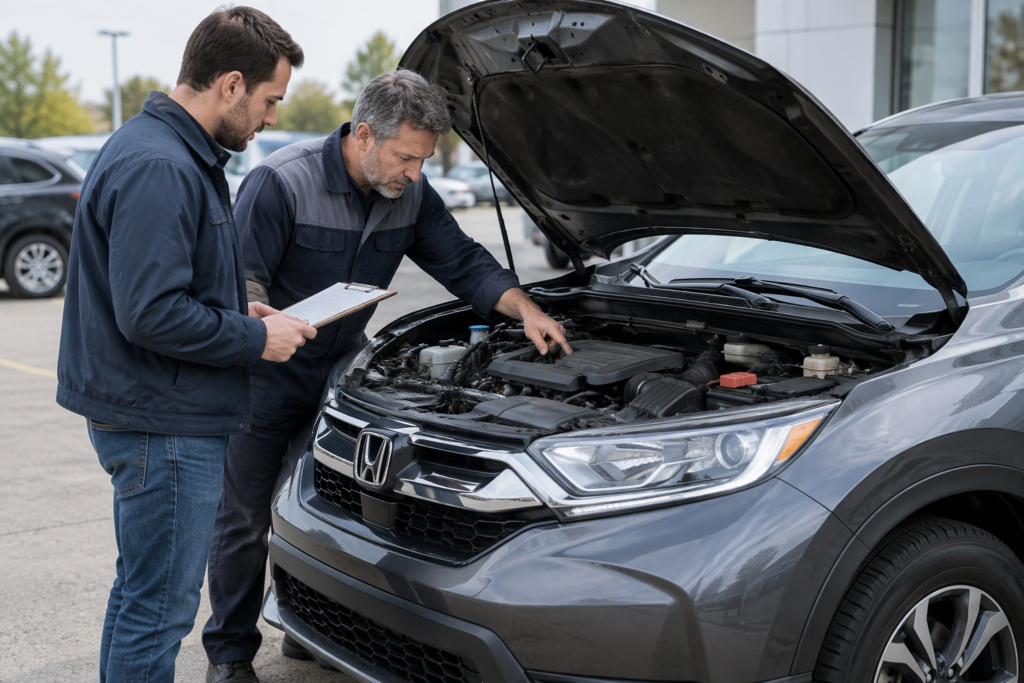
I would not rely on photographs from underneath. Surface rust, repaired corrosion, undercoating, dirt, and structural damage can look very different in person. I would put the CR-V on a lift and ask the mechanic to inspect the rear frame, trailing-arm mounts, suspension attachment points, brake and fuel lines, and any areas where corrosion may be hidden.
I would pause if the seller refuses a lift inspection, the underside has fresh undercoating that may hide repairs, the frame or mounting points show heavy corrosion, the title or ownership history is unclear, or the seller says the recall was handled but cannot provide supporting details.
If the inspection is clean, the recall position is clear, and the service history is credible, I would not reject the vehicle solely because it falls in this model-year group.
2017-2018 CR-V with the 1.5-liter turbo
For a 2017-2018 CR-V with the 1.5-liter turbo engine, I would focus on dated oil-change records and the oil-dilution product update.
I would describe this as a product update, not as a blanket statement that every vehicle has the same defect or that every CR-V in this group should be avoided. The key question is whether the update applied to that VIN and whether the work was completed.
Ask the seller for dated oil-change invoices, the current mileage and mileage at each service, the service history from the selling dealer, documentation showing whether the product update was completed, details of short-trip or cold-weather driving, and information about warning lights, rough running, or unusual engine behaviour.
I would also check the oil level and condition before the test drive. That does not prove the history of the vehicle, but it can add context to the records. The engine should start cleanly, idle consistently, and respond normally during the drive.
I would pause if the seller says, “The dealer handled it,” but cannot identify what was done. I would also pause if the oil-change records have long unexplained gaps, especially when the vehicle was used mainly for short journeys.
2023-2025 CR-V and CR-V Hybrid: confirm the steering recall
For a 2023-2025 CR-V or CR-V Hybrid, I would check the VIN for steering gearbox recall 24V-744.
A newer vehicle may still have an open safety recall. I would not assume that a recent model year removes the need for a VIN check. If the recall is open, I would ask the seller to arrange the repair before purchase and provide documentation showing what was completed.
During the test drive, I would pay attention to steering effort that changes unexpectedly, notchy or inconsistent steering, warning messages, unusual noises while turning, a steering wheel that does not return normally, pulling, wandering, or abnormal resistance.
I would not treat a normal ten-minute drive as proof that the steering system is fine. Recall status and repair documentation still matter.
What I would ask a mechanic to inspect
I would ask for a written pre-purchase inspection covering the body, frame rails, mounting points, signs of collision repair, uneven panel gaps, overspray, mismatched paint, flood or water intrusion, corrosion beneath the vehicle, and fresh undercoating that needs explanation.
The mechanic should check cold-start behaviour, oil and coolant leaks, warning lights, stored fault codes, fluid condition, rough idle, hesitation, unusual noises, transmission engagement, shift quality, overheating evidence, and poor maintenance.
I would also ask for checks of ball joints, control arms, struts, shocks, wheel bearings, tie rods, steering components, brake condition, brake-line corrosion, tyre wear, and rear-frame and trailing-arm mounts on older vehicles.
Electrical and safety checks should include airbag warning lights, stability-control and driver-assistance warnings, power windows, locks, mirrors, seats, climate controls, infotainment, cameras, hybrid warning messages, and battery or regenerative-braking behaviour on a CR-V Hybrid.
The inspection should identify what needs immediate attention, what can wait, and what should affect the price. “It drives fine” is not an inspection report.
Copy-and-paste message for the seller
Hi, I’m interested in the CR-V, but I want to verify the vehicle properly before making an offer. Please send the VIN, service records, and any recall or product-update documentation you have. I also want to confirm whether the vehicle can be inspected independently on a lift before purchase. Please provide a written out-the-door price showing the vehicle price, documentation fee, taxes, registration, dealer products, and any financing conditions. I’m not ready to place a deposit until the VIN, inspection, recall status, and complete price are clear.
When I would proceed
I would proceed when the VIN matches the vehicle and paperwork, recall status has been checked, any relevant recall repair is complete or scheduled in writing, the service history is consistent with the mileage, the inspection finds no serious structural, flood, corrosion, steering, or drivetrain problem, the seller provides a complete written price, the asking price still makes sense against similar vehicles, and the seller allows a reasonable inspection without pressure.
I would also run the listing through Deal Check before negotiating. A price can look attractive because the vehicle has a serious condition issue, an incomplete history, unusual trim, or expensive work approaching.
When I would pause
I would pause when the seller will not provide the VIN, the vehicle cannot be inspected independently, a recall or product update is described vaguely, service records are missing but the price is presented as a bargain, the title history has unexplained gaps, the vehicle has warning lights or unexplained steering, transmission, or engine symptoms, the advertised price depends on financing or a trade-in, or the out-the-door quote adds products or fees that were not disclosed.
A pause is not a rejection. It is a request for better evidence.
When I would walk away
I would walk away from serious rear-frame or structural corrosion, flood damage, a branded title that does not fit the seller’s description, a seller who refuses a VIN or independent inspection, an open safety recall where the seller refuses to arrange the repair, unexplained steering, braking, or drivetrain symptoms, a title or mileage history that cannot be reconciled, pressure to pay a deposit before inspection, or a final price that changes substantially from the advertised price without a clear explanation.
There will always be another CR-V. A low price is not a reason to accept a vehicle with a structural, safety, or documentation problem.
Bottom line
I would not use a simple “years to avoid” list as my buying decision. I would use the model year to choose the right questions.
For 2007-2011 CR-Vs, I would prioritise the VIN recall check and a lift inspection for rear-frame corrosion, especially after winters on salted roads. For 2017-2018 CR-Vs with the 1.5-liter turbo, I would require dated oil-change records and confirmation of the applicable oil-dilution product update. For 2023-2025 CR-Vs and CR-V Hybrids, I would check the VIN for steering gearbox recall 24V-744 and require the repair to be addressed before purchase if it remains open.
Then I would inspect the exact vehicle, compare its price with similar listings, and request the complete out-the-door figure.
For more negotiation context, compare the used-car pricing guide, the used-car negotiation guide, and the dealer add-ons and hidden-fees guide.
Before you make an offer, check the price, records, recalls, and inspection risks together.