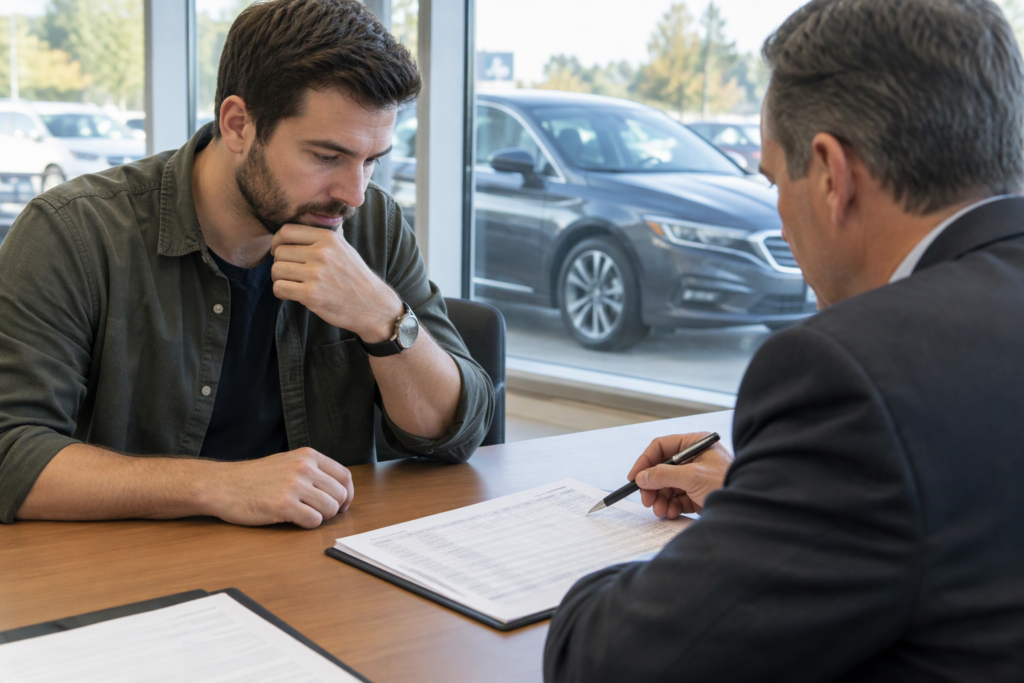
The strongest used-car negotiation starts before you make an offer. You need to know what the car is worth, what it will cost to own, which facts support a lower price and when the seller’s asking price is already fair. A confident buyer does not argue over every dollar; they make a clear offer that matches the vehicle’s condition and walk away when the numbers do not work.
Start with the asking price, not your monthly payment
Separate the vehicle’s asking price from financing, trade-in value and monthly payment. A low payment can hide a long loan term, a high interest rate or add-ons. Negotiate the vehicle price first, then review financing and trade-in numbers separately.
Before visiting, write down the advertised price, mileage, VIN, equipment, seller type and any stated fees. Save the listing if possible. Ads change, and you want the offer to be based on what was actually promised.
Use evidence that can change the price
Good negotiating evidence is specific and verifiable:
- Uneven or worn tires, brake work due soon, warning lights or fluid leaks.
- Missing service records or maintenance that the owner cannot document.
- Accident, title, flood or odometer concerns found during history and title checks.
- Equipment differences between this car and comparable local listings.
- A pre-purchase inspection that identifies safety issues or likely near-term repairs.
- Dealer fees, optional products or add-ons that were not clearly disclosed in the advertised price.
Do not claim a repair cost you have not verified. Ask a qualified shop for a written estimate, then use that estimate as part of the conversation. A vague statement such as “this probably needs a transmission” is weaker than a documented inspection finding.
Check the market before you name your number
Compare similar vehicles by year, trim, mileage, condition, location and equipment. A car with a lower sticker price may need tires, brakes or major service, while a higher-priced example may have better records and fewer immediate needs. Asking prices are not completed sales, so treat them as comparison points—not proof of what every car is worth.
You can start with the free Bidding For Autos Deal Score to review whether the asking price appears reasonable against available market listings. If you want a more detailed review, the optional Deal Check costs $9.99. It is a decision aid, not a substitute for a title check, independent inspection or professional mechanical diagnosis.
Inspect first, negotiate second
Whenever practical, arrange an independent pre-purchase inspection before finalizing the price. Choose the shop yourself, and ask for a written report. The inspection should distinguish urgent safety issues from routine wear and future maintenance.
For related checks, see how to check a used-car engine for hidden problems and how to inspect a used-car transmission. A private-party purchase also requires careful title, lien and payment checks; the private-seller checklist covers those risks.
Build an offer from the total cost
Use a simple calculation:
Offer basis = fair market comparison − documented immediate repairs − reasonable risk allowance.
This is a negotiation framework, not a guaranteed formula. Do not double-count a problem, and do not subtract a repair that the seller has already completed and documented.
Also ask for the complete out-the-door figure. Taxes, title, registration, documentation fees, dealer add-ons and other charges can change the real cost. Read the guide to dealer documentation fees if a fee appears late in the process. Ask the dealer to remove optional products you did not request and to put every charge in writing.
Make a clear, time-limited offer
State the facts, your offer and what the offer assumes: “Because the inspection found worn tires and a leaking strut, and comparable cars with similar mileage are listed lower, I can offer $X before taxes and required state fees.” Replace X with your actual number; never use a made-up market figure as if it were research.
Give the seller a reasonable chance to respond. Avoid insults, manufactured deadlines and claims that you have another identical car waiting if you do not. You can say you are prepared to buy today if the paperwork, inspection and price are acceptable without creating pressure theater.
Know when not to negotiate
Walk away or pause when the VIN does not match, the title cannot transfer, the seller refuses an independent inspection, warning lights are hidden or the final price changes without explanation. A discount does not repair a bad title or remove mechanical risk.
Sometimes the right decision is to accept a fair price. If the vehicle is correctly priced, documented, inspected and free of serious concerns, spending hours trying to force a token reduction can cost you the opportunity to buy it.
Final used-car negotiation checklist
- Separate price, financing, trade-in and add-ons.
- Verify the VIN, title status and vehicle history.
- Compare genuinely similar local vehicles.
- Get an independent inspection and written estimates.
- Use the free Deal Score, and the optional $9.99 Deal Check when you want a more detailed price review.
- Ask for the full out-the-door total in writing.
- Make a specific offer tied to evidence.
- Walk away from title problems, inspection refusals or unexplained charges.
The goal is not to “win” the negotiation. It is to buy a vehicle at a price that makes sense for its condition, history and total cost.