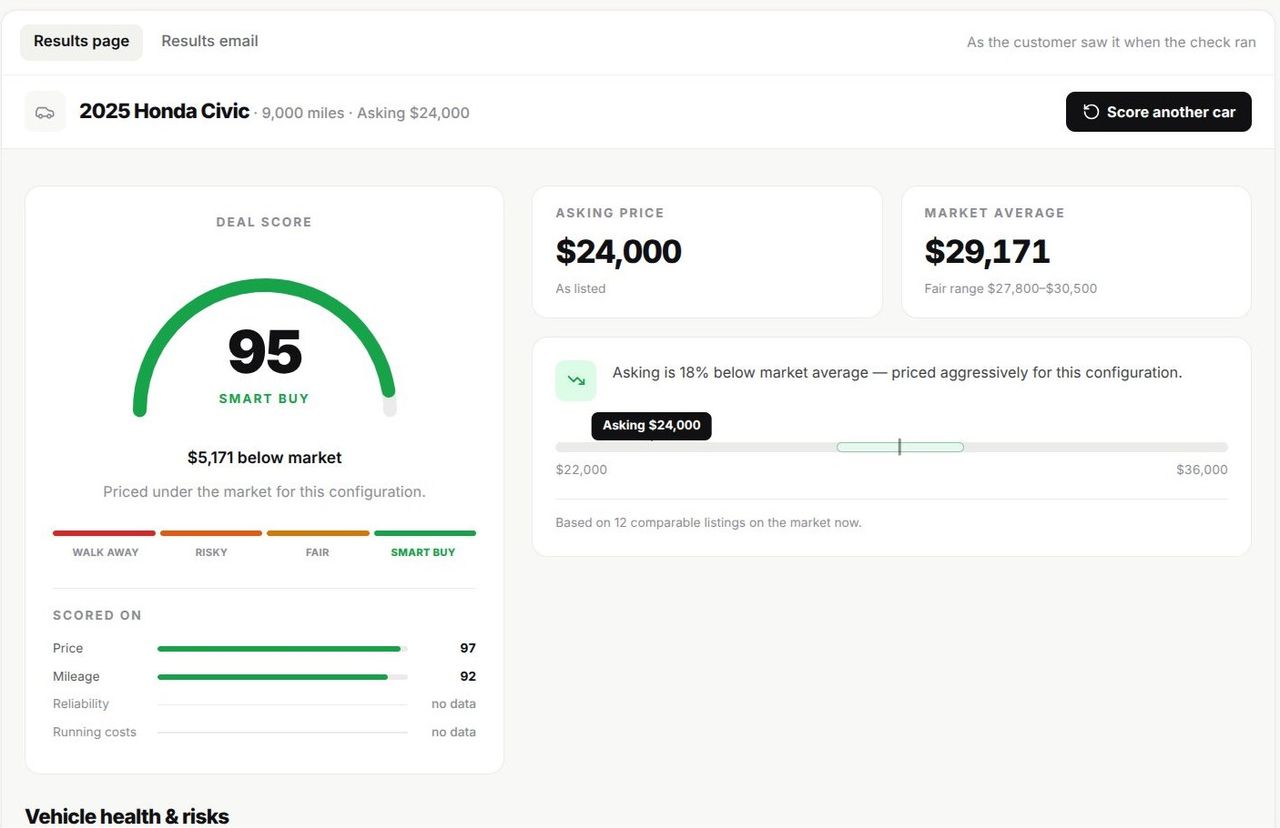
Test result: This 2025 Honda Civic had 9,000 miles and a $24,000 advertised asking price. Deal Check scored it 95/100, or “Smart Buy.” It estimated a $29,171 market average and a $27,800–$30,500 fair-price range from 12 comparable listings. The asking price was $5,171 below the estimated average, about 18% lower.
This was a test case using advertised asking prices. The Civic’s trim and VIN were unavailable, and the comparisons included different trims and model years. The result is directional, not proof of a completed-sale value, a guaranteed bargain, or a final purchase outcome.
Deal Check results
| Measure | Test result |
|---|---|
| Advertised asking price | $24,000 |
| Estimated market average | $29,171 |
| Difference | $5,171 below the estimated average |
| Deal Check score | 95/100, “Smart Buy” |
| Comparable listings | 12 advertised asking prices |
| Fair-price range | $27,800–$30,500 |
Looking at a listing right now? See how its asking price compares with similar cars.
What the result means
The test suggests that the advertised asking price compared favourably with the available advertised-price comparison set. It does not establish a completed-sale value, an appraisal, a guaranteed bargain, or a purchase outcome. The result is useful as a reason to investigate the listing further.
Why the missing trim and VIN matter
The Civic’s trim and VIN were unavailable. Different trims can have different engines, transmissions, safety equipment, technology packages, wheels, warranties, and original prices. Without the VIN, a buyer cannot confirm the exact factory configuration, title history, reported damage, ownership record, or open recall status. The comparison therefore included uncertainty that must be resolved before buying.
How to verify the listing
- Save the listing details, including price, mileage, location, photos, equipment, and date checked.
- Request the VIN and match it to the vehicle and title paperwork.
- Confirm the exact trim, engine, drivetrain, packages, keys, tyres, and included equipment.
- Build a closer comparison set using the same generation, trim, drivetrain, mileage range, condition, and local market.
- Request a written out-the-door quote showing the vehicle price, fees, taxes, title, registration, add-ons, and financing conditions.
Questions for the seller
- Has the Civic been in a collision, flood, rental fleet, or commercial use?
- Can you provide service records and a vehicle-history report?
- Are there warning lights, known repairs, open recalls, or outstanding campaigns?
- What fees and dealer-installed products are added to the advertised price?
- Will you provide the complete out-the-door quote in writing?
- May I arrange an independent pre-purchase inspection?
How condition changes the interpretation
Low mileage does not guarantee value. Inspect the body, paint, glass, wheels, tyres, brakes, suspension, lights, climate controls, infotainment, seatbelts, warning lights, fluids, and underbody. Ask for a cold start and a test drive. Check whether the odometer history matches the service records.
A clean inspection can support the view that the price is attractive. Accident damage, flood exposure, title problems, missing service, worn tyres, or unexplained warning lights can explain a lower asking price and reduce the value of the comparison.
How to read the fair-price range
The $27,800–$30,500 range is a comparison range from the test inputs, not a guaranteed price band for every 2025 Honda Civic. Because the comparisons included different trims and model years, ask what explains the gap between the $24,000 test listing and the comparison set. Do not turn the $5,171 difference into assumed savings until the exact vehicle and full price are verified.
Advertised asking prices are not sale prices
Advertised prices may exclude fees, depend on financing or a trade-in, reflect incentives that do not apply to every buyer, or change before the sale. Asking-price comparisons are still useful as an initial market signal, but they should be labelled honestly and followed by a written quote and independent inspection.
What a buyer should do next
After receiving the VIN, ask the seller for written confirmation of the exact trim and equipment. Compare the Civic with at least three closer listings, not just the broad 12-listing test set. If the closest vehicles are also near $24,000, the original result becomes more persuasive. If the closest vehicles are much lower or much higher, the original average may be less useful because the comparison set was too broad.
Next, separate the vehicle price from the purchase total. Ask for a line-by-line quote showing the advertised price, documentation or processing fee, taxes, title, registration, dealer-installed products, financing conditions, and any rebate assumptions. A price that looks $5,171 below average can lose some of its advantage if the seller adds optional products or requires terms that were not part of the listing.
Finally, arrange an independent inspection before paying a deposit. The inspection should cover the body, underbody, tyres, brakes, suspension, fluids, warning lights, electronics, climate system, test-drive behaviour, and any evidence of accident or water damage.
When the result should make you pause
Do not rely on the score if the seller will not provide the VIN, if the title history is unclear, if the vehicle cannot be inspected, if the advertised price depends on a trade-in or financing condition, or if the final quote contains unexplained products.
Inspection and recall checks
- Match the VIN to the listing, vehicle, and title.
- Check the exact VIN through the official NHTSA recall lookup.
- Review title and history records for accidents, flood damage, branding, and ownership gaps.
- Ask for maintenance records and verify major work where possible.
- Arrange an independent inspection before paying a deposit.
- Review documentation fees, add-ons, taxes, registration, and financing conditions.
An open recall is not automatically proof that the vehicle should be rejected, but the buyer should know what the recall involves and whether the repair has been completed. A seller who refuses basic history or inspection access creates a separate reason to pause.
Related buyer guides
Use the used-car pricing guide to compare asking prices, read the opening-offer guide before negotiating, and review the dealer add-ons and hidden-fees guide before accepting a quote.
Bottom line
This test produced an encouraging signal: the 2025 Honda Civic was advertised at $24,000, scored 95/100, and compared $5,171 below the estimated $29,171 average from 12 advertised asking prices. The trim and VIN were unavailable, the comparison set included different trims and model years, and no purchase outcome was verified. The right conclusion is not “buy this Civic.” It is “verify this listing carefully.”
Before you make an offer, review the comps, fees, and inspection questions.