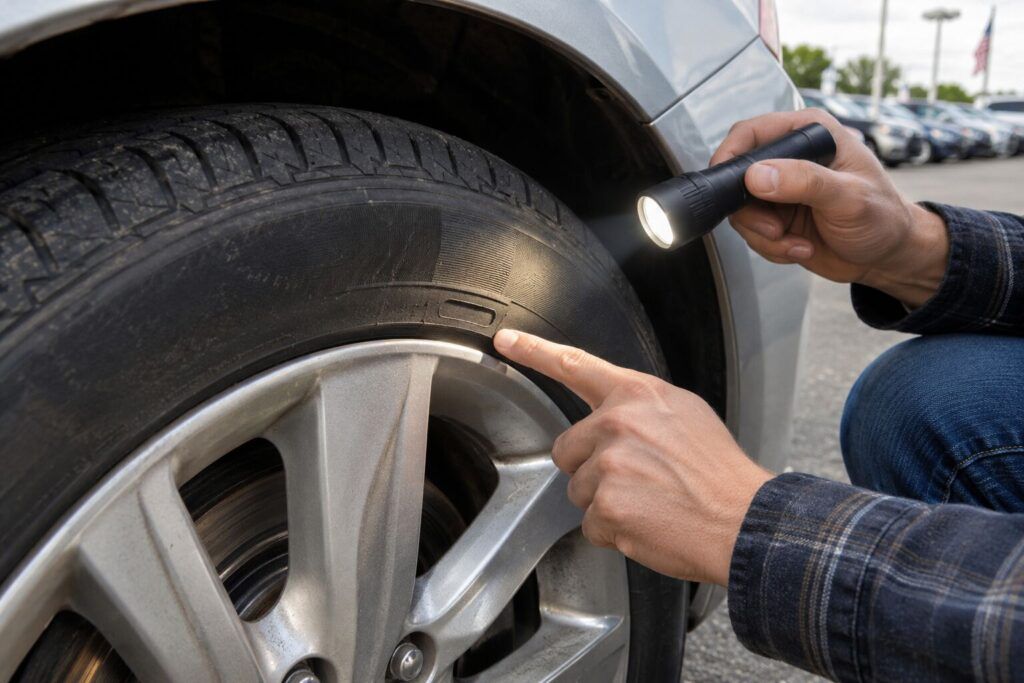
Yes—you can check a used car’s tire age before buying by reading the four-digit date code in the tire’s DOT identification number. The last two digits show the production year, and the first two digits show the week of production. For example, a code ending in 231 is incomplete or not the full modern four-digit date code; a valid example such as 2324 means the tire was made in the 23rd week of 2024. Check all four tires because they may not have been installed at the same time.
Tire age is only one part of a vehicle decision. Tread depth, cracking, uneven wear, tire type, maintenance history and the car’s asking price also matter. For a broader ownership-risk checklist, start with the Bidding For Autos buyer guides, then use the Free Instant Deal Score when you have the vehicle details.
Where to find the tire date code
Look for the letters DOT followed by a series of letters and numbers on the tire sidewall. The date code is usually the final four digits inside an oval or separate grouping. The complete code may appear on only one side of the tire, so you may need to look at the inner sidewall or turn the steering wheel to inspect the front tires.
If you cannot see the four-digit date code, do not assume the tires are new. Ask the seller to show the code on each tire, or have an independent inspection include tire identification and condition.
How to read the four-digit date code
- First two digits: production week, from 01 through 52 or 53.
- Last two digits: production year.
- Example: 3523 means the 35th week of 2023.
The code identifies when the tire was manufactured, not when it was installed. A tire made in 2023 could have been installed in 2024 or later, and a spare may be older than the other tires.
Do not confuse the date code with the tire size. A marking such as 225/60R17 describes width, aspect ratio, construction and wheel diameter; it is not the tire’s age.
Why tire age matters
Rubber changes over time, even when a tire has plenty of tread. Heat, sunlight, storage conditions, underinflation and long periods of sitting can accelerate deterioration. Older tires may show sidewall cracking, hardened rubber, bulges or separations that are not obvious from a quick walk-around.
Age alone does not prove that a tire is unsafe, and a date code does not replace a professional inspection. But older tires deserve closer examination and should be part of your cost calculation.
Check all four tires—not just the one facing you
Record the date code, brand, model and size for each tire. Then compare them:
- Are all four the same size and suitable for the vehicle?
- Are the front and rear tires different ages?
- Is one tire a different brand or model?
- Do the tires have matching speed and load ratings where required?
- Is the spare older, damaged or missing?
Mixed tires are not automatically a deal-breaker, but differences can affect handling and wet-weather performance. Ask why a tire was replaced. A newer tire may reflect a puncture, curb damage, alignment problem or normal replacement—it is a clue to investigate, not proof of a hidden defect.
Look beyond the tread measurement
Ask for the tread depth on each tire, measured rather than guessed. Also inspect:
- Cracks between tread blocks or along the sidewall
- Bulges, cuts, punctures or exposed cords
- Uneven wear on the inner or outer shoulder
- Cupping or scalloped wear that may suggest suspension or balance problems
- Different wear patterns from one side of the vehicle to the other
Uneven wear can point to alignment, worn suspension parts, incorrect inflation or a bent wheel. Ask whether the vehicle has had a recent alignment and request the inspection results rather than relying on a verbal assurance.
Illustrative replacement-cost example
The figures below are hypothetical and illustrative only. Actual prices depend on tire size, brand, vehicle, taxes, installation and local labor.
- Four replacement tires: $720
- Mounting and balancing: $120
- Disposal and shop charges: $40
- Illustrative total: $880
If a seller is asking $18,900 and the tires appear near the end of their service life, do not automatically subtract $880 dollar-for-dollar from the offer. First confirm the tire condition, compare installed replacement quotes and check for related alignment or suspension work. Then use the documented cost as evidence in your price discussion.
Questions to ask the seller
- What are the date codes on all four tires and the spare?
- When were the tires installed?
- Have any tires been repaired or replaced after a puncture or impact?
- Has the vehicle had an alignment recently?
- Can I arrange an independent pre-purchase inspection?
- Are the tire-pressure warning light and spare-tire equipment working?
A seller who cannot answer every question may simply lack the records. Treat missing information as something to verify, not as evidence that the car is bad.
When tire condition should change your decision
Pause the purchase or lower your maximum price when you find severe cracking, a bulge, exposed cords, unsafe damage, substantially mismatched tires or wear that suggests an unresolved mechanical problem. Walk away if the seller refuses a reasonable inspection or will not let you verify basic safety items.
Do not drive on a visibly damaged tire just to complete a test drive. Ask for the vehicle to be inspected safely or arrange transport.
Bottom line
Read the four-digit DOT date code on every tire, inspect the sidewalls and tread, compare wear patterns, and price the likely replacement work before you make an offer. Tire age is a useful risk signal, but the final decision should combine condition, service evidence, inspection findings and the full purchase price.
For another price check, enter the vehicle’s details in the Free Instant Deal Score before you buy.